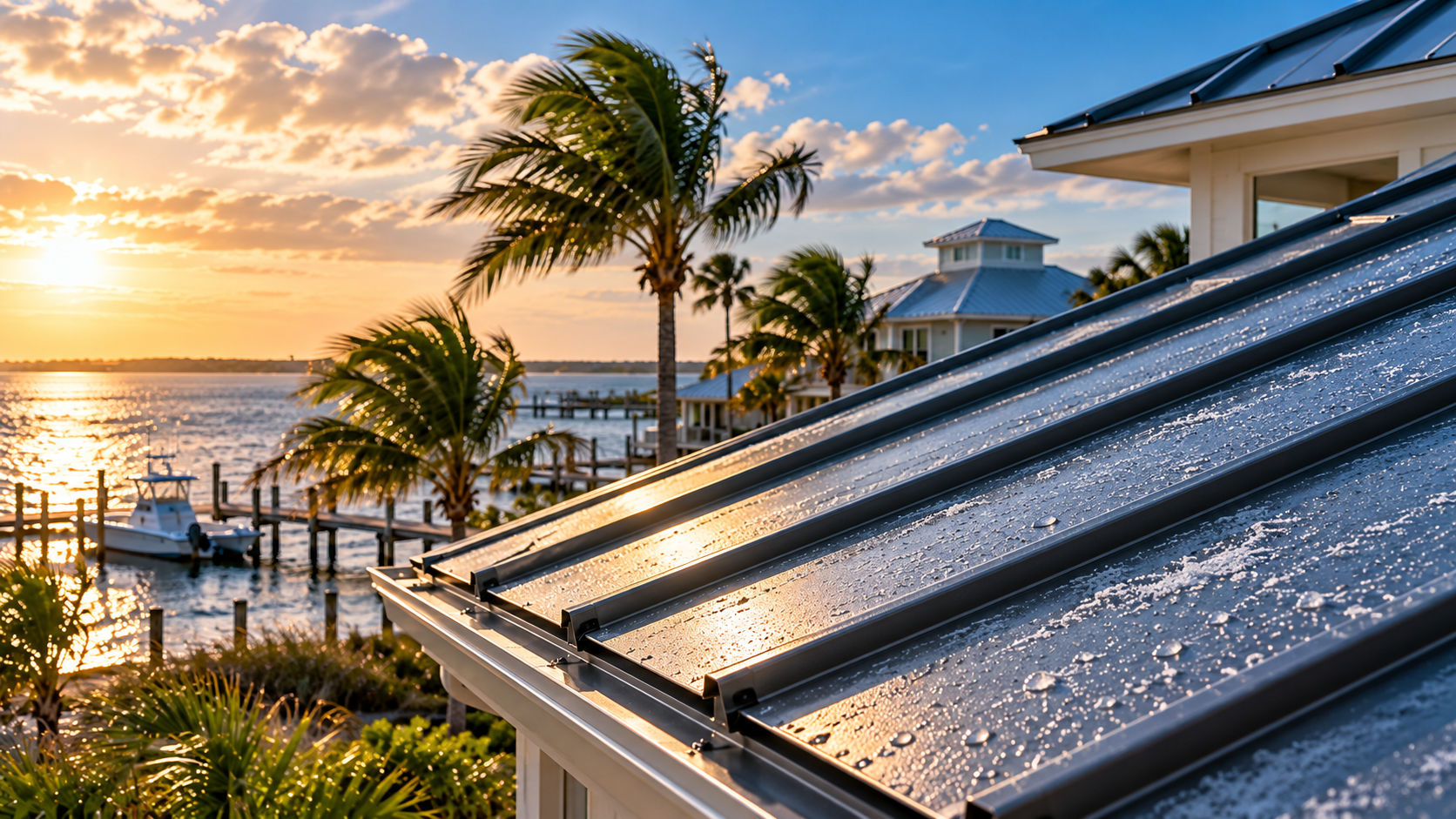
As a Florida roofing contractor, you know all about the weather we deal with. While the surf and sun definitely help make Florida a great place to live, all that heat, humidity, heavy rain, and, dare we say, hurricanes can sure create issues for our homes and businesses. But one thing we need to talk about more is the salt in the air.
Our coastal winds carry salt particles inland, where they can take up residence on roofing panels, fasteners, flashing, and other components that help keep our buildings standing tall. Over time, that exposure can lead to corrosion, especially when you add moisture. And there’s no denying that there’s plenty of moisture in Florida.
This article helps contractors understand salt exposure. With this insight, our team at 1st Coast Metal Roofing Supply hopes you can make better-informed material and installation decisions for your clients.
How Does Salt Air Affect Metal Roofing?
Let’s talk about ocean water for a moment, considering we’re almost surrounded by it. The ocean has a salinity of about 3.5%. What does that mean? Put simply, it means that for every kilogram of seawater, there are about 35 grams of dissolved salt. Think of that as table salt, along with magnesium, calcium, and potassium.
So why are we providing these science facts? It’s because salt doesn’t stay in the ocean. Ocean spray and coastal winds carry salt particles through the air, where they can settle on metal roofing surfaces. When those salt deposits mix with moisture from rain, humidity, or condensation, they can speed up corrosion.
Properly coated metal surfaces are generally more resistant to corrosion. However, scratches, cut edges, fasteners, and areas where water collects can be more vulnerable. Pay attention to flashing, clips, screws, and other metal components, too.
Of course, not every coastal roof faces the same level of exposure. Distance from the shoreline, wind direction, direct ocean spray, and how often rain washes away salt deposits can all make a difference.
Which Metal Roofing Materials Perform Better Near the Coast?
Florida has approximately 1,350 miles of coastline. But when you factor in bays, inlets, and islands, that number jumps to 8,436 miles of tidal shoreline. That’s a lot of opportunities for salt air to affect our buildings.
So, what should contractors consider when choosing metal roofing materials for coastal projects? Here are three popular choices that we think should be considered over other options:
- Galvanized steel has a protective zinc coating that helps resist corrosion. However, cut edges and damaged coatings can be more vulnerable to salt exposure. Not all galvanized products are recommended for coastal environments.
- Galvalume-coated steel uses an aluminum-zinc alloy coating to protect against corrosion. It’s commonly used for metal roofing, but some manufacturers restrict its use near saltwater. Always check product specifications before ordering.
- Aluminum doesn’t develop red rust like steel. It naturally forms a protective oxide layer, making it a popular choice for coastal roofing. However, it can still corrode under certain conditions and has different strength, expansion, and fastening requirements.
Keep in mind that there is no perfect material for every single project. So, be sure to check project specifications and manufacturer recommendations before deciding which path you want to take.
Don’t Overlook the Other Materials You Need
Although it’s a major consideration, choosing corrosion-resistant roofing panels is only part of the project. You also need to consider the other materials that make up the roofing system. These components face the same coastal conditions and need to stand the test of time, too.
- Fasteners should resist corrosion and be approved for the roofing system. Certain grades of stainless steel may be suitable, depending on the application.
- Flashing and trim should be compatible with the roofing panels and able to withstand salt exposure.
- Clips and connectors can also corrode, even when they’re not easily visible.
- Sealants and washers should meet manufacturer recommendations for coastal installations.
Remember, using incompatible metals together can also cause galvanic corrosion when moisture is present.
Your Installation Practices Matter
There’s a reason that your clients hire you to do the job, and it’s not just about helping them pick the right metal roofing and siding materials. It’s because you’re good at what you do, and your installation practices show it. And in Florida in particular, how you install your roofing and siding materials can make or break how well they hold up to salt exposure over time.
Here are a few practices to keep in mind when working on coastal projects:
- Protect the panels by avoiding scratches and other damage when unloading, handling, and installing materials.
- Clean up metal filings left behind from cutting or drilling. These small particles can rust and stain the roof.
- Follow the manufacturer’s cutting instructions, including any recommendations for protecting exposed edges.
- Keep materials dry by storing panels properly and preventing moisture from getting trapped between them.
- Use compatible accessories that are approved for the roofing system and coastal conditions.
Even materials designed to resist corrosion can experience problems if they’re not handled or installed correctly. A little extra attention during installation can help prevent costly repairs and callbacks later.
Check Manufacturer Warranties
Always take the time to check manufacturer warranties before you place an order or begin installation. They may vary and affect your decisions. Some warranties restrict installations near oceans, bays, or other saltwater areas. Coverage may depend on the type of metal, protective coating, and distance from the shoreline. You may also need to follow specific installation requirements.
Before ordering, confirm that the materials are approved for the project’s location and review any exclusions. This can help prevent costly surprises and later disagreements with clients.
Plan for Salt Exposure Early On
Don’t be caught off guard during your project or after. Remember that salt exposure is a regular concern if you’re working near the coast. Corrosion resistance depends on the complete roofing system, not just individual panels or components.
Taking time to select compatible materials, review manufacturer recommendations, and follow proper installation practices can help prevent problems down the road. And if you have questions about material options for an upcoming coastal project, the team at 1st Coast Metal Roofing Supply is here to help.
Have Questions? Contact us at 1st Coast Metal Roofing Supply to discuss your roofing and siding needs and one of our expert team members will answer all your questions.
